by Mohamed Elbebhairy | Dec 7, 2025 | Products
If you are doing business in Saudi Arabia right now, you are in the middle of one of the biggest infrastructure booms in history. Vision 2030 is transforming the landscape.
But with rapid growth comes strict regulation.
The General Directorate of Civil Defense (GDCD) in Saudi Arabia does not play games. If your facility isn’t up to code, you aren’t just risking a fine. You are risking your license, your reputation, and your revenue.
So, how do you navigate the complex web of fire safety regulations without losing your mind?
You don’t do it alone. You hire the best.
Today, I want to talk about Advanced Systems, and why they are the Civil Defense-approved partner you need to scale safely.
The “Hidden” Cost of Non-Compliance
Most entrepreneurs focus on marketing, sales, and logistics. They treat fire safety as a “check-the-box” task.
This is a huge mistake.
In Saudi Arabia, the Salamah regulations are rigorous. The Civil Defense requires certified vendors for installation, maintenance, and supervision.
If you cut corners here, you face:
-
-
Operational Downtime: The government can seal your doors until you are compliant.
-
Insurance Nightmares: If a fire happens and your systems weren’t certified, your coverage is likely void.
-
Brand Damage: Trust is hard to build and easy to lose.
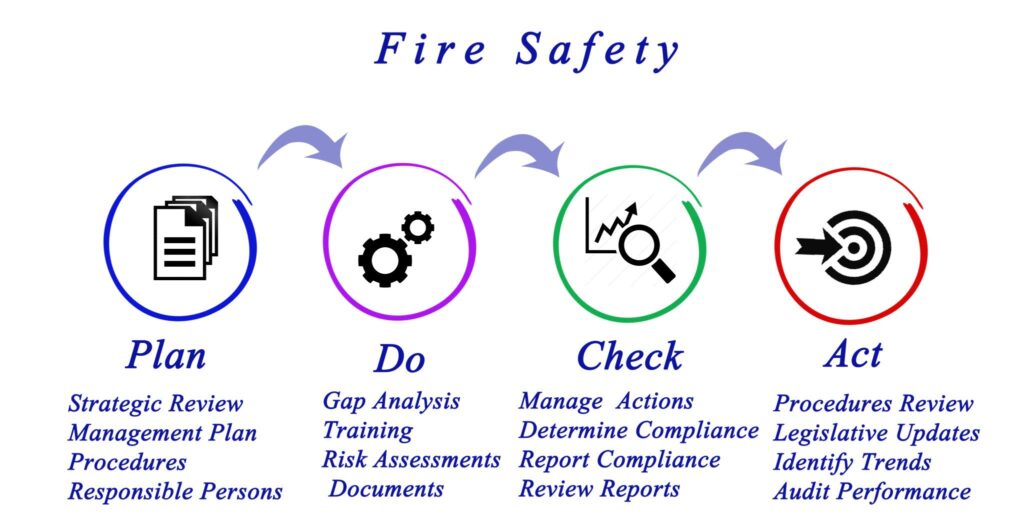
Fire Safety
You need a partner that understands the local ecosystem.
Enter: Advanced Systems
There are dozens of fire safety companies in KSA. Why am I highlighting Advanced Systems?
Because in business, speed and precision matter.
Advanced Systems isn’t just a hardware vendor; they are a compliance solution. They are fully approved by the Civil Defense to handle the heavy lifting for you.
Here is why they stand out from the competition:
1. End-to-End Certification (The “Done-For-You” Approach)
You don’t have time to deal with three different contractors—one for design, one for installation, and one for the legal paperwork.
Advanced Systems handles the entire lifecycle. From the initial engineering drawings approved by the Civil Defense to the final installation of sprinklers, alarms, and pumps.
2. Smart Technology Integration
We live in a digital world. Your fire safety shouldn’t be stuck in the 1990s.
Advanced Systems utilizes modern fire detection tech that integrates with building management systems. This means faster response times and fewer false alarms.
3. Maintenance That Actually Happens
Getting the certificate is step one. Keeping it is step two.
The Civil Defense requires regular maintenance logs. Advanced Systems provides scheduled maintenance contracts that keep you “audit-ready” 24/7/365.
How Safety Drives ROI
You might be thinking, “Neil, how does buying fire extinguishers give me a Return on Investment?”
It’s simple. Stability.
Investors and big partners in Saudi Arabia look for risk mitigation. When you can prove that your facility (whether it’s a warehouse, a hotel, or an office tower) is secured by a top-tier provider like Advanced Systems, your valuation goes up.
You are signaling to the market that you are a serious player.
Here is the bottom line:
You can spend months trying to figure out the regulations yourself, or you can partner with Advanced Systems, get your license, and get back to what you do best—growing your business.
Don’t let a safety audit be the bottleneck that stops your growth.
by Mohamed Elbebhairy | Dec 3, 2025 | Products
You spend thousands on insurance, maintenance, and compliance, yet you still have that nagging fear: What happens when the worst-case scenario hits?
Most business owners think a fire suppression system is just a necessary evil—a bulky, expensive box to check for compliance.
You are wrong.
If your system is simply “compliant,” you’re setting yourself up for financial disaster. Because a traditional system doesn’t just put out a fire; it often destroys your most valuable assets in the process.
This is the hidden cost your insurance agent never tells you about.
But there is a different way. A way to turn your fire protection from a simple cost center into a Business Continuity Asset.
That’s where Advanced Systems comes in.
The TRUTH About Old-School Fire Protection (And Why It’s Killing Your Cash Flow)
You’ve got sprinklers, right? Great. But let me drop a shocking statistic on you:
Water damage from traditional fire suppression systems often accounts for 60-70% of the total claim cost, even in small fires.
Think about it. You’re protected from fire, but now your server room is flooded, your inventory is ruined, and your critical machinery is corroded.
Here are the three ways your old system is secretly draining your bank account:
-
Massive Downtime: Water damage requires weeks of cleanup and restoration. How much revenue do you lose every hour your business is shut down?
-
Asset Annihilation: Your high-value electronics, data centers, and irreplaceable archives cannot survive a drenching. You pay twice: once for the system, and again when it destroys the assets it was supposed to protect.
-
The Compliance Trap: Your system might meet the bare minimum code, but the code doesn’t care about your profit margin. It just cares that you have something. You need a strategic solution, not a basic one.
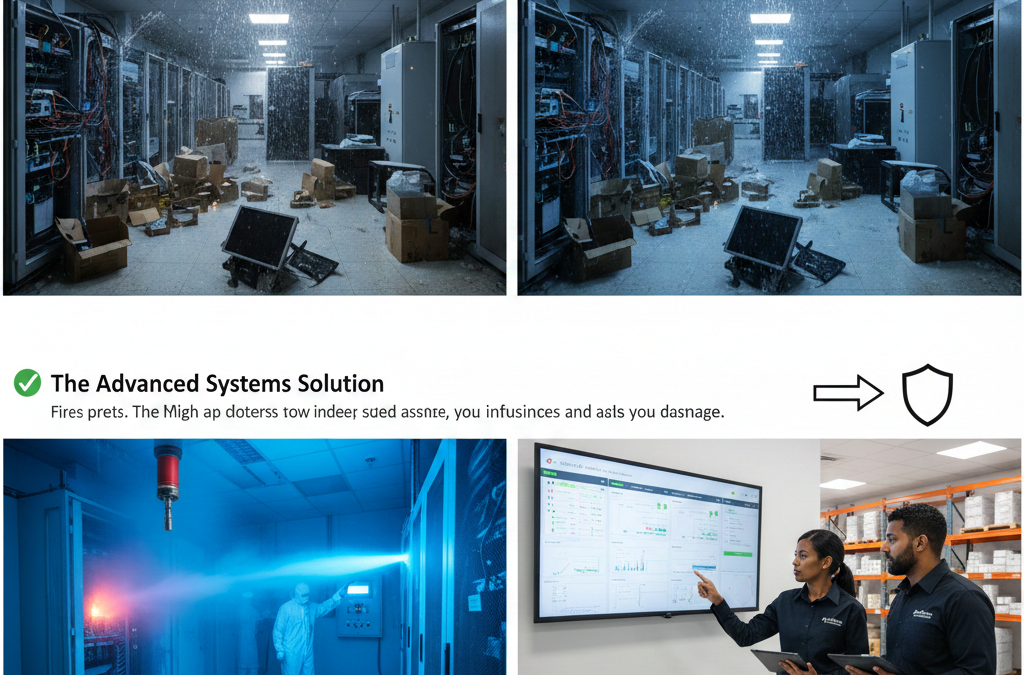
The Advanced Systems Solution: Protecting Assets, Not Just Buildings
Advanced Systems doesn’t sell equipment; they sell uninterruptible business operation. They specialize in advanced, precision fire suppression that is custom-engineered to your specific risk profile.
Here’s the 3-Step Strategy they use to safeguard your business and ROI:
1. Precision Clean Agent Technology: Zero Damage. Zero Residue.
Forget water. Advanced Systems leverages Clean Agent Fire Suppression (like FM-200 or Novec 1230) for your mission-critical areas.
What does this mean for your business?
-
Rapid Extinguishment: The fire is put out in seconds, before it can spread.
-
No Cleanup Required: These are gas-based systems that disappear after discharge. You can literally be back online in minutes, not weeks.
-
The ROI: Drastically reduced downtime and eliminated asset loss translate directly into massive savings and uninterrupted revenue.
2. Risk-Based Zoning (Stop Treating All Risks Equally)
Do you protect a file cabinet the same way you protect a $5 million CNC machine? Of course not.
Advanced Systems identifies your Highest-Value Assets (HVA)—server racks, electrical panels, control rooms—and installs independent, specialized micro-systems for targeted protection.
3. Proactive Monitoring & Certification: The Sleep-at-Night Factor
Compliance paperwork is nice, but real protection is better. Advanced Systems offers 24/7 intelligent monitoring and a rigorous maintenance schedule that predicts failures before they happen.
They don’t wait for your system to break. They ensure it never does.
This proactive approach guarantees compliance, minimizes emergency service calls, and ensures that when the moment of truth arrives, your investment pays off immediately.
Final Verdict: Are You Investing in Safety, or Just Paying a Fee?
The most expensive fire suppression system is the one that fails, or the one that saves your building but destroys your business.
Advanced Systems gives you the strategic advantage of advanced technology, asset-focused design, and guaranteed uptime.
You have two choices:
-
Keep throwing money at outdated systems that put your business at risk of catastrophic water damage and downtime.
-
Contact Advanced Systems today. Get a custom, clean-agent risk audit that shows you exactly how much money and time you can save by implementing a modern, intelligent fire suppression strategy.
Stop fearing the fire. Start investing in true business continuity.
Ready to upgrade your protection from a cost to an asset? [Click to chat ]
by Mohamed Elbebhairy | Dec 2, 2025 | Events
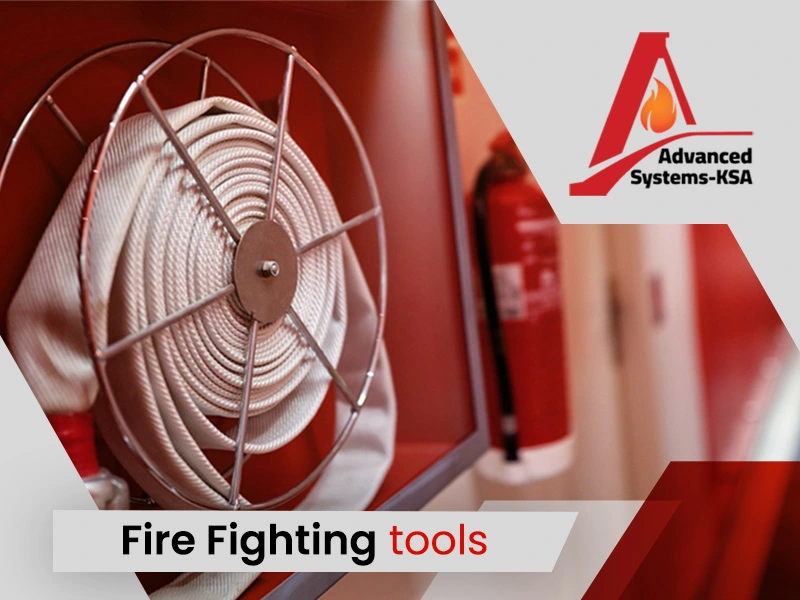
When combating fires, having the right firefighting tools and equipment is crucial for firefighters’ safety and the blaze’s successful containment. In this article, we will explore essential firefighting equipment tools and their functions to understand their importance in emergencies better.
Firefighting Tools And Equipments overview
Foam
Foam firefighting is a technique widely used to extinguish flammable liquid fires. Foam acts as a barrier, separating the fuel from the oxygen, thus suppressing the fire. Foam firefighting equipment includes foam concentrate, foam generators, and foam nozzles. These tools are designed to deliver the foam most effectively, ensuring maximum fire suppression capabilities.
Water Firefighting
Water is the most commonly used firefighting agent due to its availability and accessibility. Water firefighting equipment includes fire hydrants, fire hoses, and water monitors. Firefighters employ high-pressure water streams to cool the fire, remove heat, and extinguish flames. The water delivery systems are designed to provide a controlled and powerful water flow to reach the fire source and douse it efficiently.
Fire Alarm Systems
Fire alarm systems are essential in alerting building occupants to evacuate during a fire emergency. These systems consist of smoke detectors, heat detectors, and fire alarm control panels. Smoke detectors detect the presence of smoke particles, while heat detectors monitor temperature changes. When triggered, these devices send signals to the fire alarm control panel, which activates audible and visual alarms, ensuring swift evacuation and prompt response from firefighters.
Hydrants and Standpipes
Hydrants and standpipes are critical components of the water supply system for firefighting. Hydrants are outdoor water outlets connected to the municipal water supply, allowing firefighters to quickly access a reliable water source. Standpipes, on the other hand, are vertical pipes installed within buildings, enabling firefighters to connect hoses and access water on multiple floors. These tools provide easy access to water, facilitating effective firefighting operations.
Mist Systems
Mist systems are an innovative firefighting technology that uses fine water droplets to suppress fires. These systems create a mist that absorbs heat and reduces oxygen levels, ultimately extinguishing the fire. Mist systems are beneficial in areas where water damage needs to be minimized, such as data centers, museums, and server rooms. They offer an efficient and environmentally friendly firefighting solution.
FM-200 Gas Systems
FM-200 gas systems, or clean agent fire suppression, extinguish enclosed space fires without harming sensitive assets. The colorless, odorless gas removes heat and interrupts the chemical chain reaction. They are widely used in valuable equipment areas like server rooms and archives.
CO2 Firefighting
CO2, a firefighting agent for electrical and flammable liquid fires, extinguishes by displacing oxygen, suffocating the fire. Common in industrial, laboratory, and electrical equipment settings, CO2 use requires caution due to potential harm in high concentrations.
Firefighting Control Panel
The firefighting control panel acts as the central command hub for overseeing and managing fire protection systems within a building. Integrating components such as fire alarms, sprinkler systems, smoke detectors, and emergency communication systems, the panel enables firefighters to assess situations, activate suppression systems, and efficiently coordinate firefighting efforts.
Advanced Systems is committed to delivering advanced firefighting tools and equipment field. Our success is rooted in a robust technical team providing expert guidance throughout the project and using top-quality products from renowned manufacturers worldwide.
know more about:
Fire water pump
Fire Alarm Devices
Fire Alarm Panels
Firefighting Water Sprinkler Network
Fire hydrant manufacturers in Saudi Arabia
Fire hydrant and monitor is to keep lives safe
Foam Firefighting Equipment in Saudi Arabia
Fire Cabinet Hose Suppliers in KSA
by Mohamed Elbebhairy | Dec 2, 2025 | Events
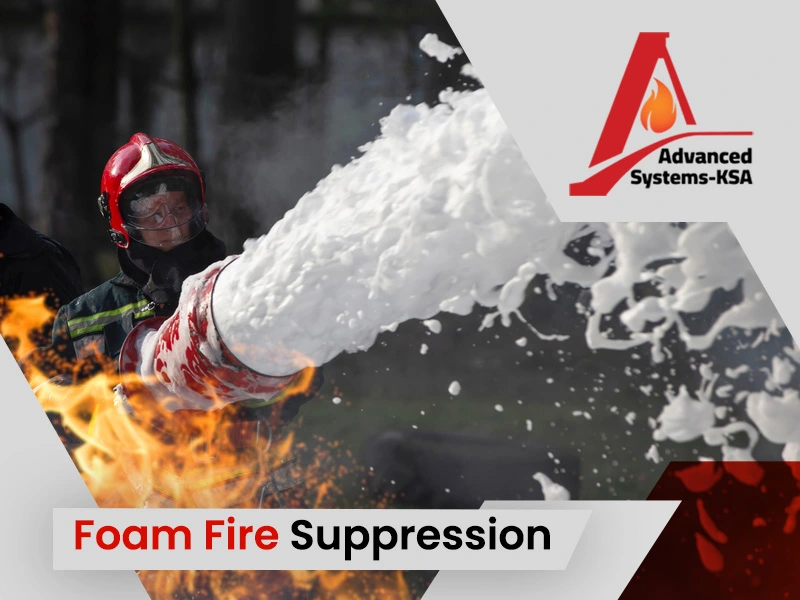
Fire accidents pose a significant threat to lives and properties, making it crucial to invest in reliable fire suppression systems. If you seek foam fire suppression for sale in KSA, Advanced Systems, a leading firefighting solutions provider, can be your partner. The company offers a wide range of high-quality products, including foam fire suppression systems, designed to combat fires effectively.
This article will explore the features and benefits of foam fire suppression systems and how Advanced Systems is revolutionizing fire safety in the Kingdom of Saudi Arabia (KSA).
Foam Fire Suppression Systems: A Powerful Defense Against Fires
Foam fire suppression is employed to suppress and extinguish fires by applying a specialized foam formulated to smother the fire, preventing oxygen ingress into the fuel source.
The foam used in fire suppression typically consists of water, foam concentrate, and air. The foam concentrate is a chemical additive that helps to create a stable foam with specific firefighting properties. Different foam concentrates are available, each designed for different types of fires.
When the foam is applied to a fire, it expands and forms a thick blanket or layer over the burning material. This blanket prevents the release of flammable vapors and cools the fuel surface, helping to suppress the fire. The foam also acts as a barrier, preventing the fire from spreading to nearby areas.
Applications and Techniques of Foam Fire Suppression Systems
Foam fire suppression systems can be used in various settings, including industrial facilities, airports, oil refineries, chemical plants, and military installations. They are particularly effective for combating flammable liquid fires, such as those involving petroleum, oil, and gasoline.
Foam application methods for fire suppression include fixed systems and portable equipment. Fixed systems, such as foam sprinkler systems, are permanently installed in buildings or structures and automatically activate when a fire is detected. Mobile foam equipment, such as foam extinguishers or generators, can be manually operated and carried to the fire location.
It’s important to note that foam fire suppression should be used following specific guidelines and recommendations to ensure its effectiveness and safety. Proper training and understanding of the specific fire hazards and foam application techniques are crucial for effective fire suppression.
The Foam Fire Suppression For Sale In KSA: Unmatched Quality And Reliability
Introducing Advanced Systems’ unparalleled foam fire suppression for sale in KSA, our commitment to delivering top-notch firefighting solutions reaches Saudi Arabia. With a seasoned technical team, we bring a wealth of experience in fire protection, ensuring optimal choices for safeguarding your assets.
The foam fire suppression for sale in KSA from Advanced Systems guarantees unmatched quality and reliability. We provide cost-effective, high-quality solutions to protect lives, properties, and assets from the peril of fire and its consequences. Call us now.
know more about:
Fire hydrant and monitor
Fire Hose Cabinet Types
Firefighting Tools And Equipments
Fire Alarm Devices

by Mohamed Elbebhairy | Dec 2, 2025 | Events
Fire hydrants are crucial in safeguarding our communities by providing a reliable water supply for firefighting operations. These essential devices come in various types and configurations, each designed to meet specific needs and address unique challenges. In this article, we will explore the types of fire hydrants and the purposes they serve, highlighting their features and the situations in which they are most commonly employed.
How many types of fire hydrants ?
Most commonly that hydrant’s above ground, but fire hydrants extend several feet below ground as well, For most intents and purposes, there are two types, wet and dry barrel hydrants, in addition to other types

How many types of fire hydrants ?
Types of Fire Hydrants
Fire hydrants come in various types and configurations designed to meet specific needs and requirements.
Dry Barrel Hydrant
Dry Barrel Hydrants are specialized fire hydrants designed to withstand freezing temperatures in cold climates. These hydrants have an internal valve below the frost line, allowing for water drainage when the hydrant is not in use. By removing the water from the barrel, the dry barrel hydrant prevents freezing, damaging the hydrant and hindering its functionality during emergencies.
When firefighters need to access water from a dry barrel hydrant, they connect their hoses to the outlet valve, and water flows into the barrel, providing a reliable water supply for firefighting operations. These hydrants are essential in regions with cold weather, ensuring firefighters can access water quickly and effectively, even in freezing conditions.
Wet Barrel Hydrant
Wet Barrel Hydrants are a commonly used types of fire hydrants designed for areas with milder climates where freezing is not a concern. Unlike dry barrel hydrants, damp barrel hydrants remain filled with water even when unused. The barrel’s water is constantly present, allowing quick and easy access during firefighting operations.
Wet barrel hydrants typically have a main valve above the ground, making them easier to operate and maintain. These hydrants provide a reliable, readily available water supply, eliminating the need for draining and refilling processes. Wet barrel hydrants are widely used in urban and suburban areas, ensuring efficient firefighting capabilities when emergencies arise.
Pillar Hydrant
The pillar hydrant represents the fundamental and simplest form of a fire hydrant. It comprises a vertical pipe with an outlet valve, serving as a vital connection point for firefighters to access water during firefighting operations.
Typically mounted on a sturdy concrete or metal pillar, the pillar hydrant is strategically positioned throughout communities to ensure easy accessibility. Firefighters connect their hoses to the outlet valve, providing a direct water supply to extinguish fires. This basic yet essential hydrant type provides the necessary resources for effective firefighting and protecting lives and property.
Flush Hydrant
Flush hydrants serve a specific function of flushing water mains to eliminate sediment buildup or stagnant water. These hydrants are typically smaller than standard fire hydrants and have lower flow rates. Their primary purpose is to facilitate the thorough cleaning of water distribution systems. Opening the flush hydrant forces water to be forcefully released, creating a strong flow that helps dislodge and remove accumulated sediment or stagnant water.
This process improves water quality, reduces the risk of blockages, and maintains the integrity of the water supply. While flush hydrants may not be intended for firefighting purposes, they play a critical role in ensuring the efficiency and cleanliness of water mains.
In conclusion, understanding the various types of fire hydrants, such as dry barrel, wet barrel, pillar, and flush hydrants, is essential for maintaining effective firefighting capabilities and water distribution systems in different environments and conditions. Contact “Advanced Systems” now for a consultation for the most appropriate type.