by Mohamed Elbebhairy | Feb 2, 2026 | Events
Fire fighting fittings are vital in fire protection systems. They play a key role in controlling and putting out fires.These fittings facilitate the efficient flow of water or other extinguishing agents from hydrants, pumps, and hoses to the fire site, enabling firefighters to swiftly and effectively combat emergencies.
In this article, we will explore the diverse range of fire fighting fittings and their functions, shedding light on their significance in safeguarding lives and property.
Fire fighting Fittings Types
Fire Hose Couplings
Fire hose couplings are essential for seamlessly connecting fire hoses and other firefighting equipment. These fittings enable the secure and efficient transfer of water or firefighting foam. There are different types of fire hose couplings available, depending on regional standards and requirements. There are several types of couplings:
- Instantaneous couplings: such as Storz and Nakajima couplings, are widely used due to their quick and reliable connection mechanisms. They feature symmetrical lugs that interlock when the couplings are joined, ensuring a tight seal.
- Threaded couplings: including National Pipe Thread (NPT) and British Standard (BS) couplings, rely on threaded connections for secure attachment. These couplings require careful matching of thread sizes and types for proper functionality.
- Quarter-Turn Couplings: They offer rapid connection with just a quarter-turn twist. They are commonly used in some European countries and are gaining popularity in other regions due to their ease of use.
Fire Hydrant Fittings
Fire hydrants are vital components of fire protection systems, providing a readily available water supply for firefighting operations. Fire hydrant fittings allow fire hoses to be connected and disconnected easily, ensuring a swift response to fire incidents. These fittings include:
- Hydrant valves: regulate the flow of water from the hydrant to the fire hose.
- Adapters: help in connecting hoses of different sizes or coupling types to the hydrant.
- Caps: protect the hydrant outlets from debris and ensure their functionality during emergencies.
Regular maintenance and inspection of fire fighting fittings, including hydrant fittings, are necessary to ensure proper operation. This includes checking for leaks, ensuring smooth valve operation, and verifying the integrity of adapter threads.
Fire Hose Nozzles
Fire hose nozzles are critical for controlling the flow and direction of water or firefighting foam during fire suppression efforts. This type of fire fighting fittings determines the spray pattern and flow rate, allowing firefighters to adapt to different fire scenarios effectively. Several types of fire hose nozzles are available, each with its specific features.
Adjustable fog nozzles allow firefighters to adjust the spray pattern from a concentrated stream to a wide fog pattern. This flexibility is useful when dealing with different fire sizes and types. Smooth bore nozzles have a fixed orifice size, providing a concentrated stream for effective penetration into the fire. Combination nozzles offer a combination of both fog and straight stream patterns, providing versatility in firefighting operations.
Choosing the appropriate nozzle type depends on factors such as the available water supply and the desired firefighting technique. Regular inspection and maintenance of fire hose nozzles are essential to ensure their proper functionality.
Fire Pump Fittings
Fire pumps are essential for boosting water pressure in fire protection systems, ensuring an adequate water supply to fight fires. The fire pump fittings’ role is to connect the pumps to water sources and piping systems. This type of fire fighting fittings includes:
- Suction strainers: They prevent debris from entering the fire pump, protecting its internal components.
- Suction and discharge flanges: These provide secure connections between the pump and the piping system.
- Check valves: These valves allow water to flow in one direction, preventing backflow and maintaining system pressure.
To ensure that fire pump fittings operate and perform reliably, they must be installed meticulously and maintained consistently. This involves tasks such as examining suction strainers for any obstructions, scrutinizing the condition of gaskets and seals, and validating the effectiveness of check valves through testing.
Fire Sprinkler Fittings
Fire sprinkler systems are a vital component of fire protection in buildings, providing automatic fire suppression capabilities. Fire sprinkler fittings connect the sprinkler piping network, ensuring the proper distribution of water in case of a fire. These fittings include sprinkler heads, risers, and tees.
- Sprinkler heads: They are the visible part of the system and activate when exposed to high temperatures.
- Risers: connect the main water supply to the sprinkler system
- Tees: allow the branching of the piping network.
This type of fire-fighting fittings must be carefully selected, installed, and tested to ensure their proper operation during fire emergencies. Their maintenance includes checking for corrosion, ensuring proper alignment of sprinkler heads, and verifying the integrity of riser connections.
Fire Extinguisher Fittings
Firefighing Tools
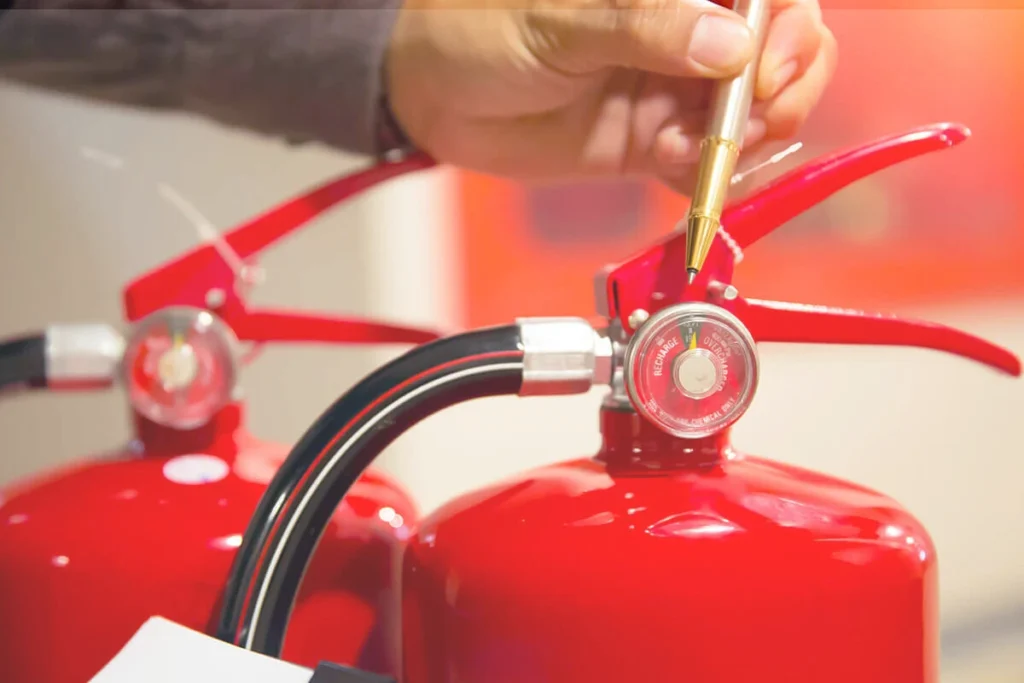
Fire extinguishers are portable devices used for immediate fire suppression. These devices often have specific fittings to connect hoses or nozzles for the discharge of extinguishing agents. Fire extinguisher fittings typically include valves, discharge horns, and pressure gauges. The following explains the function of each one:
- Valves: Valves in fire extinguishers regulate the flow of extinguishing agents, allowing users to control the discharge.
- Discharge horns: These are attachments that direct the flow of the extinguishing agent, ensuring it reaches the desired target.
- Pressure gauges: They provide visual indications of the pressure within the extinguisher, allowing users to monitor its readiness for use.
Checking for leaks, verifying the condition of valves and discharge horns, and ensuring accurate pressure readings are important steps in their maintenance.
Conclusion
Fire fighting fittings are indispensable components of fire protection systems, enabling the effective control and extinguishment of fires. From fire hose couplings to fire extinguisher fittings, each type of fitting plays a specific role in ensuring the reliability and efficiency of firefighting operations.
Proper selection, installation, and maintenance of fire fighting fittings are of the utmost importance. Regular inspections, testing, and adherence to industry standards and regulations are necessary to ensure the functionality and safety of these fittings.
Contact Advanced Systems now and get a consultation regarding the appropriate fire fighting fittings in your porperty’s firefighting system.
Read More:
The Best Fire Sprinklers Companies
fire hydrant and monitor
Fire Hydrant Pump
Foam Firefighting Equipment in Saudi Arabia
Fire Hose Cabinet Price
Fire Alarm Types
Conventional Fire Alarm Panels
by Mohamed Elbebhairy | Jan 8, 2026 | Products
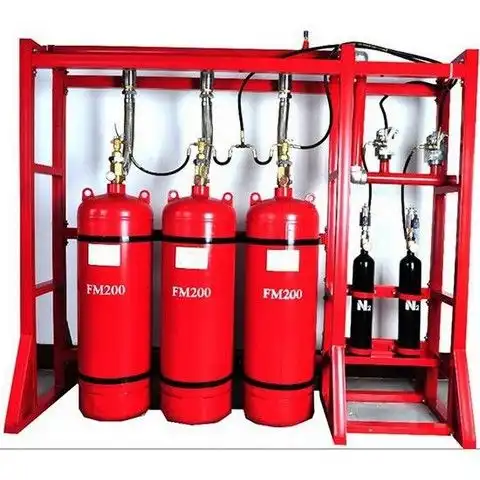
Beyond Water: Protecting Your Future with FM-200 and Advanced Systems
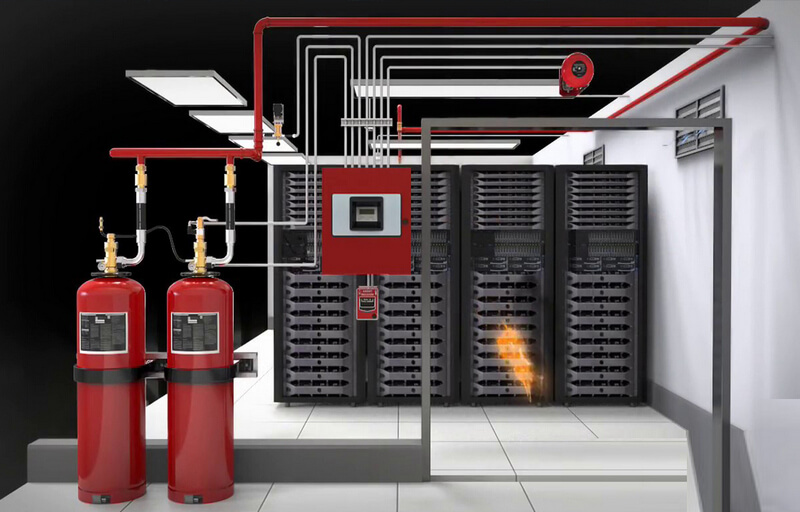
In a world where data is as valuable as gold and electronics drive every facet of modern business, the traditional approach of “putting out fires with water” is often as damaging as the fire itself. For mission-critical environments, a fire doesn’t just represent a physical threat; it represents potential data loss, hardware destruction, and crippling downtime.
This is where the FM-200 Fire Suppression System becomes the gold standard, and Advanced Systems provides the expertise to make it a reality.
What is FM-200?
FM-200 (chemically known as HFC-227ea) is a colorless, odorless “clean agent” gas. Unlike water or foam, it is stored as a liquid and discharged as a vapor. It works by disrupting the fire triangle at a molecular level—specifically by absorbing heat—effectively stopping a fire before it can even take hold.
The Five “Zeroes” of FM-200
When Advanced Systems designs an FM-200 solution for your facility, we focus on the five critical “zeroes” that define this technology:
-
Zero Residue: After discharge, the gas simply evaporates. There is no powder, oily film, or water to clean up, allowing you to resume operations immediately.
-
Zero Damage to Electronics: FM-200 is electrically non-conductive and non-corrosive. It is perfectly safe for server racks, telecommunications gear, and delicate medical equipment.
-
Zero Oxygen Depletion: One of the biggest myths is that FM-200 works by “suffocating” the fire. In reality, it leaves oxygen levels high enough for people to breathe and evacuate safely .
-
Zero Ozone Depletion: It is an eco-friendly replacement for older Halon systems, meeting global environmental standards.
-
Zero Time Wasted: FM-200 systems reach extinguishing levels in 10 seconds or less. In fire safety, every second counts.
Why Choose Advanced Systems?
Installing a gaseous suppression system requires more than just hardware; it requires precision engineering. Advanced Systems brings a specialized approach to every project:
-
Bespoke Design: We don’t believe in “off-the-shelf” safety. We calculate the exact volume of your room and the specific density of the gas required to ensure total flooding without over-pressurization.
-
Seamless Integration: Our systems are designed to communicate directly with your existing building management systems (BMS), automatically shutting down fans and closing dampers the moment a fire is detected.
-
Compliance & Certification: We ensure your installation meets all local and international fire codes (such as NFPA 2001), providing you with the necessary certification for insurance and safety audits.
-
Lifetime Maintenance: From semi-annual pressure checks to room integrity testing, Advanced Systems provides the ongoing support needed to ensure your system is ready for the moment it’s never supposed to happen.
Applications
FM-200 is the ideal choice for any high-value environment, including:
-
Data Centers & Server Rooms
-
Laboratories & Medical Imaging Suites
-
Museums & Historical Archives
-
Telecommunication Hubs
-
Control Rooms
Secure Your Assets Today
Don’t wait for a disaster to discover that your fire protection isn’t enough. Protect your equipment, your data, and your peace of mind with a clean agent solution from the experts.
by Mohamed Elbebhairy | Jan 7, 2026 | Products
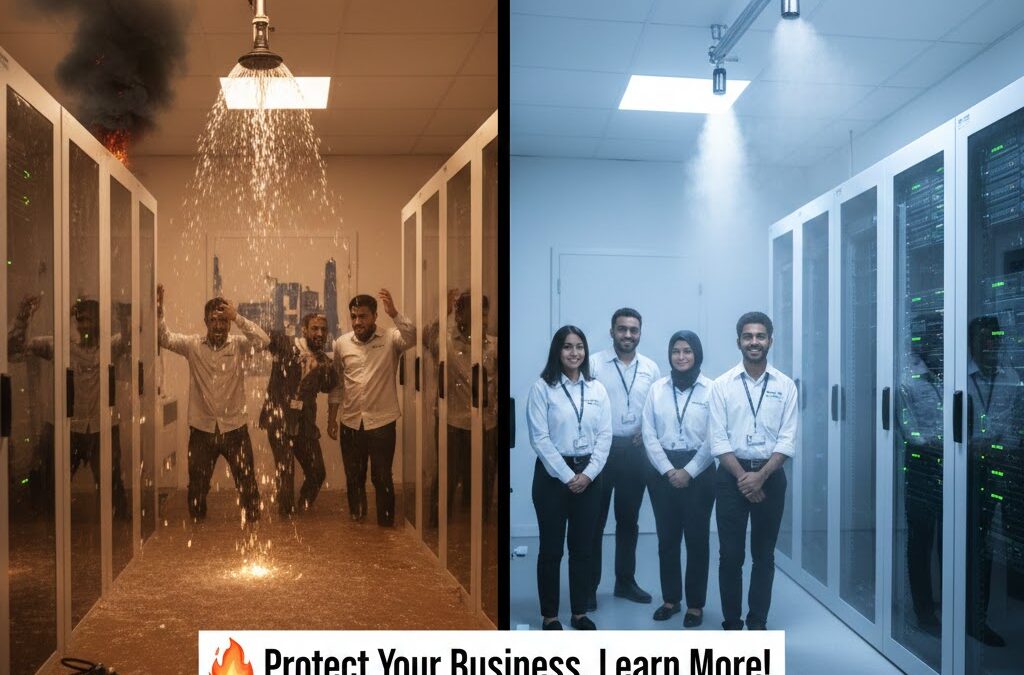
You are running a successful operation in Saudi Arabia. Your server room is the brain of your company. It holds your customer data, your financial records, and your proprietary software.
Suddenly, a small electrical short triggers a fire alarm.
The standard sprinkler system kicks in. Thousands of liters of water flood the room.
The good news? The fire is out. The bad news? Your servers are fried. Your data is corrupted. Your business is offline for weeks.
You didn’t lose money because of the fire. You lost money because of the water.
If you are protecting high-value assets—electronics, archives, or medical equipment—water is not your friend.
You need a “Clean Agent” system. Specifically, you need Novec 1230.
And if you want it installed right, you need Advanced Systems.
What is Novec 1230? (The “Magic” Liquid)
I don’t usually get excited about chemicals, but Novec 1230 is revolutionary.
It looks like water. You can pour it into a glass. You can even dip your iPhone into a beaker of it, pull it out, and the phone will still work perfectly.
Why? Because it is electrically non-conductive and leaves zero residue.
When the system triggers, Novec discharges as a gas, suppresses the fire in less than 10 seconds, and then… it just evaporates.
-
No water damage.
-
No cleanup costs.
-
No corrosion.
You literally just turn the fans on, and you are back to work.
Why “Advanced Systems” is Your Novec Expert
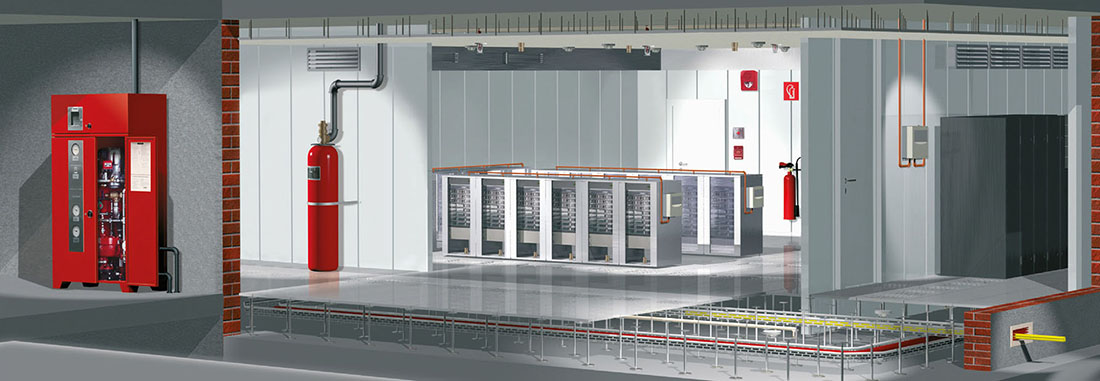
Here is the catch. You can’t just buy a tank of Novec and put it in the corner.
For this system to work, the engineering has to be flawless. This is why I recommend Advanced Systems.
Designing a Novec system requires complex hydraulic flow calculations. If the pressure isn’t right, the gas won’t fill the room fast enough to stop the fire.
Advanced Systems handles the technical heavy lifting:
1. Room Integrity Testing
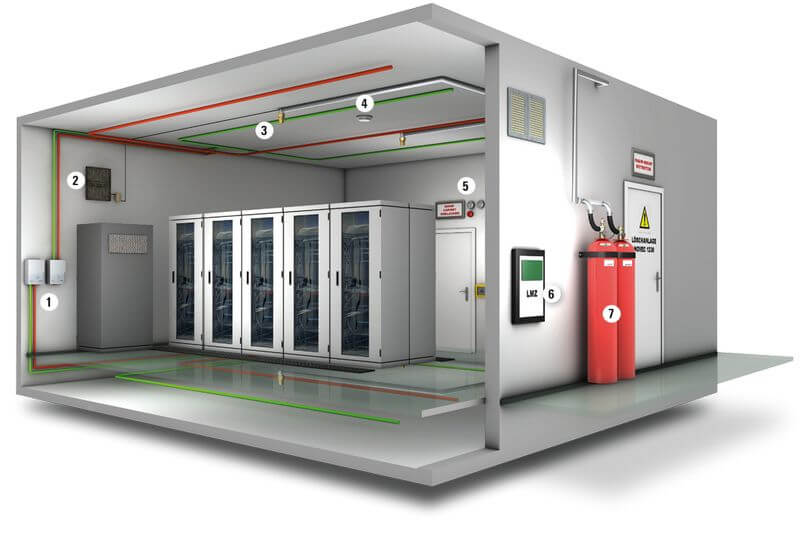
Novec works by flooding the room with gas. If your room isn’t sealed properly, the gas leaks out, and the fire reignites. Advanced Systems conducts rigorous “Door Fan Tests” to guarantee your room can hold the agent.
2. Civil Defense Compliance
In Saudi Arabia, using clean agents requires specific approvals. Advanced Systems ensures your Novec installation meets the strict standards of the Saudi Civil Defense (GDCD) and NFPA 2001 regulations.
3. Sustainability (The Green Factor)
We all know Saudi Arabia is moving toward a greener future with the Saudi Green Initiative. Old systems (like FM200) are being phased out globally due to global warming potential.
Novec 1230 has a Global Warming Potential of 1. It is the most eco-friendly solution on the market. Advanced Systems helps you future-proof your facility so you don’t have to rip out your equipment in five years when regulations change.
📈 The Ultimate Fire Suppression System Showdown
If you are a facility manager or business owner, this is the only data you need to see. This table shows you the true cost (and risk) of each option:
| Feature |
Novec 1230 (Clean Agent) |
FM-200 (Clean Agent) |
Water Sprinklers (Traditional) |
| Agent Type |
Chemical/Fluid (Non-residue) |
Chemical/Gas (Non-residue) |
Water |
| Suppression Time |
< 10 Seconds |
< 10 Seconds |
30–60 Seconds (Delay inherent) |
| Damage to Assets |
None (Electrically non-conductive) |
None (Electrically non-conductive) |
Severe (Corrosion, short circuits) |
| Cleanup Required |
None (Evaporates fully) |
None (Evaporates fully) |
Extensive (Water extraction, drying, mold risk) |
| Environmental Impact (GWP) |
Ultra-Low (GWP = 1) |
Medium (GWP = 3,220) – Being phased out |
None (but wastes resources) |
| Storage Pressure |
Low Pressure (Safer storage) |
High Pressure |
Low Pressure |
| Best For |
Data Centers, Archives, Control Rooms, Museums |
Critical Areas (Older facilities) |
Warehouses, Offices, Non-Sensitive Areas |
| Conclusion |
Future-Proof, High-Value Protection |
Functional, but environmentally sensitive |
High Risk for Electronic |
The Math Behind the Investment
I know what you are thinking. “Neil, Novec sounds expensive.”
Yes, the upfront cost is higher than a water sprinkler. But let’s look at the ROI.
-
Cost of Novec System: $$$
-
Cost of replacing a Data Center: $$$$$$
-
Cost of 2 weeks of Downtime: $$$$$$$$$
Cheap is expensive.
When you partner with Advanced Systems, you aren’t buying a fire extinguisher. You are buying Business Continuity.
You are ensuring that if the worst happens, your downtime is measured in minutes, not months.
Conclusion
Don’t let a 10-minute fire destroy 10 years of work.
If you have servers, archives, or expensive machinery, ditch the water. Upgrade to Novec 1230.
Contact Advanced Systems today. Let them assess your facility, run the calculations, and give you the protection your business deserves.
by Mohamed Elbebhairy | Dec 24, 2025 | Events
Fire safety is a paramount concern in any environment, whether residential, commercial, or industrial. Implementing effective firefighting systems is crucial in mitigating the risks associated with fires. It is essential to understand the different types of systems available and how they each help address unique fire risks.
This article will explore the question, “How many types of firefighting systems?” and the diverse range of systems designed to combat different types of fires.
Water-Based Fire Suppression Systems
-
Wet Pipe Sprinkler Systems
Wet pipe sprinkler systems, the most prevalent water-based fire suppression method, maintain a constant water supply within pipes. This ensures an immediate response to fire events, making them ideal for various settings. Their straightforward design, quick response time, and low maintenance requirements contribute to their reliability in safeguarding commercial buildings, residential spaces, and warehouses.
-
Dry Pipe Sprinkler Systems
Designed to address freezing concerns, dry pipe sprinkler systems utilize pressurized air or nitrogen instead of water, releasing water only when a sprinkler head is activated. This innovative approach makes them suitable for environments where freezing is risky, providing effective fire protection in unheated warehouses or cold climate parking garages.
-
Pre-Action Sprinkler Systems
Pre-action systems require a two-step activation, filling pipes with air first and releasing water upon fire detection. It is suitable for areas sensitive to accidental discharges.
Deluge systems use open sprinklers connected to a water supply for rapid, simultaneous water application. Effective in high-hazard environments with a need for intense water discharge.
-
High-Pressure Water Mist Systems
Utilizing fine water droplets and high-pressure water mist systems cool fires, displace oxygen, and inhibit combustion reactions. Ideal for environments where water damage is a concern.
Read More: Fire Hydrant Pump Prices
Gas-based fire suppression systems
Gas-based fire suppression systems, including clean agent and carbon dioxide (CO2) systems, play a pivotal role in advanced fire safety. Clean agent systems employing gases like FM-200 or inert gases swiftly reduce oxygen levels, extinguishing fires without residue. CO2 systems are highly effective for flammable liquids and electrical fires, displacing oxygen to starve the fire.
These systems find applications in data centers, server rooms, museums, and industrial facilities, offering rapid and efficient suppression without water damage. While advantageous, careful consideration is crucial due to safety concerns associated with certain gases. This evolving technology continues to refine gas-based systems for enhanced fire protection.
Foam-based fire suppression systems
Foam-based fire suppression systems are essential for effectively controlling flammable liquid fires, offering versatility and rapid response in high-risk environments. Foam sprinkler systems release a blanket of foam over fuel surfaces, preventing the release of flammable vapors commonly applied in chemical plants and industrial settings. High-expansion foam systems designed for enclosed spaces generate large volumes of foam to smother fires in places like aircraft hangars.
The advantages of foam-based systems lie in their quick and efficient suppression, particularly tailored for flammable liquid hazards. However, applying foam may pose challenges regarding clean-up and potential water damage. Thorough risk assessments are crucial to determining the most suitable foam type and concentration for specific fire risks, ensuring a comprehensive fire safety strategy in diverse industrial and commercial settings.
Read More: The Foam Fire Suppression for Sale in KSA
Powder-based fire suppression systems
Powder-based fire suppression systems, exemplified by dry chemical systems using ABC or BC powders, are versatile solutions that interrupt combustion processes in various fire classes. Their adaptability makes them valuable in industrial facilities, commercial buildings, and electrical rooms where fire hazards exist. These systems are essential for comprehensive fire safety and offer a rapid and effective response. However, their use may result in residue and clean-up challenges, emphasizing the importance of thorough risk assessments and carefully selecting powder types tailored to specific fire risks to ensure optimal suppression in diverse environments.
How many types of firefighting systems exist?
Other systems may include:
- Specialized Systems: CO2 systems effectively tackle electrical and flammable liquid fires, suppressing flames without residue. Fire hydrant systems provide essential water sources for manual firefighting efforts in various settings.
- Fire Extinguishers: portable devices with specific agents for small-scale firefighting, including water, foam, dry powder, and CO2, tailored for distinct fire classes.
In conclusion, the question “How many types of fire fighting systems?” unveils various solutions tailored to address different fire hazards. Implementing the right combination of fire suppression systems based on a thorough risk assessment is crucial for ensuring the safety of occupants and assets. Advanced Systems provides tailored firefighting services. Contact us now.
Read Also :
Fire Cabinet Hose Suppliers in KSA
Fire water booster pump
Conventional Fire Alarm Panels
Fire hydrant and monitor
Fire Alarm Devices
Fire water pump manufacturers

by Mohamed Elbebhairy | Dec 24, 2025 | Products
Siex Automatic Fire Suppression System (member of Komtes Group), Spain, Europe origin.
Siex is one of the fastest growing companies in the industry in recent years.
They manufacture and distribute systems, such as water systems, water mist systems, clean agents & other gases (CO2, NOVEC1230, FM200), tube systems, and kitchen hoods.
In an era where data, heritage, and high-value infrastructure are the lifeblood of global enterprise, the traditional “sprinkler and water” approach to fire safety is often as damaging as the fire itself. This is where the synergy between Siex, a world leader in fire suppression technology, and Advanced Systems, a premier provider of integrated safety solutions, becomes a critical asset for modern businesses.
Below is a unique exploration of why the Siex Fire Suppression System, implemented by Advanced Systems, represents the pinnacle of asset protection.
The Philosophy of “Clean” Protection
The core of the Siex system is its “Clean Agent” philosophy. Unlike water or powder, which leave residues that can corrode circuit boards or destroy ancient manuscripts, Siex agents are designed to disappear.
1. SIEX-NC™ 1230 (The Ecological Pioneer)
As one of the most sustainable chemical gases on the market, the SIEX-NC™ 1230 uses a fluorinated ketone that acts swiftly during the incipient stage of a fire.
-
Speed: Discharges in seconds to suppress fire before it can generate significant heat.
-
Environment: Boasts zero Ozone Depletion Potential (ODP) and a negligible Global Warming Potential (GWP).
-
Safety: It is non-conductive and safe for occupied spaces, ensuring personnel can evacuate without respiratory distress.
2. INERT-SIEX™ (The Atmospheric Solution)
Advanced Systems often recommends INERT-SIEX™ (using Nitrogen, Argon, or IG-541) for environments where total sustainability is the goal. These systems work by reducing oxygen levels to a point where combustion cannot be sustained, yet remaining at a level safe for human breathing.
-
Long Pipe Runs: Because inert gases can be stored at high pressures (up to 300 bar), Advanced Systems can design layouts where the cylinder bank is located far from the protected hazard, saving valuable floor space.
Why “Advanced Systems” is the Integral Link
A fire suppression system is only as effective as its design and maintenance. Advanced Systems bridges the gap between Spanish engineering (Siex) and local implementation.
Precision Engineering & Design
Every facility is unique. Advanced Systems utilizes specialized hydraulic calculation software to ensure that the gas concentration reaches every corner of a room within the strict 10-second window required by NFPA and ISO standards. Whether it’s a high-ceiling server farm or a compact electrical cabinet, the design is tailored to the specific volume of the space.
The “SIEX-trace” Advantage
For localized hazards like CNC machines or electrical panels, Advanced Systems deploys SIEX-trace. This system uses a pressurized pneumatic tube that acts as both a detector and a delivery mechanism. When a fire occurs, the tube ruptures at the hottest point, releasing the extinguishing agent directly onto the source—stopping the fire before it triggers a building-wide alarm.
Global Certifications, Local Expertise
The partnership ensures that every installation meets the most rigorous international benchmarks:
Primary Applications
Advanced Systems specializes in deploying Siex technology across critical sectors:
-
Data Centers: Protecting servers from both fire and “acoustic damage” (using Siex’s specialized silencer nozzles).
-
Museums & Libraries: Ensuring that priceless artifacts are never touched by water.
-
Telecommunications: Maintaining 24/7 uptime by preventing corrosive residue.
-
Hospitals: Safeguarding expensive MRI and diagnostic equipment.
Conclusion: Beyond Extinguishment
Choosing a Siex Fire Suppression System through Advanced Systems is not just a regulatory checkmark; it is an investment in business continuity. In the event of a fire, the goal isn’t just to put the flames out—it’s to ensure that you can turn the power back on and resume operations within the hour.
Expert Note: Advanced Systems provides end-to-end support, from the initial “Door Fan Test” (to ensure room integrity) to periodic refilling and maintenance of the cylinder banks.
Page 6 of 11« First«...45678...»Last »