by Mohamed Elbebhairy | Dec 24, 2025 | Events
A firefighting system combines equipment, devices, and procedures to detect, control, and extinguish fires. It includes various components that work together to minimize the impact of fires and protect life, property, and the environment. This guide explores the significance of these systems and their diverse applications.
Types of Firefighting Systems
There are several types of firefighting systems designed to detect, control, and extinguish fires. Here are some common types:
Water-Based Systems
- Sprinkler Systems: Automatic sprinkler systems are widely used and consist of a network of pipes with sprinkler heads that release water when heat is detected. They are effective in suppressing fires and controlling their spread.
- Water Mist Systems: These systems disperse fine water droplets to cool the fire and reduce oxygen levels. Water mist systems are suitable for a wide range of applications and can be used in areas where water damage needs to be minimized.
Gaseous Suppression Systems
- Carbon Dioxide (CO2) Systems: The CO2 firefighting system displaces oxygen, reducing its concentration and suffocating the fire. They are commonly used in areas with sensitive equipment and materials, such as electrical rooms or server rooms.
- Clean Agent Systems (e.g., FM-200, Novec 1230): These firefighting systems use clean agents that do not leave residue or damage sensitive equipment. They are suitable for protecting valuable assets in areas such as control rooms, data centers, or museums.
Foam-Based Systems
- Foam Sprinkler Systems: These firefighting systems discharge foam, which creates a blanket that separates the fuel from oxygen, suppressing the fire. They are commonly used in areas with flammable liquids, such as warehouses or chemical storage facilities.
- Foam Pourer Systems: Foam pourer systems deliver foam directly onto the fuel surface, providing rapid fire suppression. They are often used in areas with flammable liquid storage tanks or helipads.
Dry Chemical Systems
These systems use dry chemical powders, such as ABC or BC powder, to extinguish fires by interrupting the chemical reaction. They are versatile and suitable for various fire hazards, including flammable liquids, gases, and electrical fires.
Smoke Management Systems
- Smoke Exhaust Systems: These systems remove smoke from a building, improving visibility for occupants and aiding evacuation.
- Pressurization Systems: Pressurization systems create a pressure differential to prevent the movement of smoke into protected areas, such as stairwells or escape routes.
- Smoke Curtains: Smoke curtains are deployed to contain or channel smoke, preventing its spread to other areas of the building.
Elements of A Firefighting System
The following is a breakdown of the elements that must be present in every firefighting system:
Fire Detection
Fire detection involves the use of smoke detectors, heat detectors, flame detectors, or a combination of these devices to identify the presence of a fire. Once a fire is detected, it triggers an alarm to alert occupants and initiates the response sequence.
Fire Suppression Systems
These systems are designed to extinguish fires or control their spread. They can be categorized into two main types:
- Active Fire Suppression: These systems use agents such as water, foam, gas (e.g., CO2), or chemicals to extinguish the fire. Examples include the systems mentioned above as water mist systems, gas suppression systems, and foam systems.
- Passive Fire Suppression: These systems are designed to contain or slow down the spread of fire. Examples include fire-resistant doors, fire-resistant walls, fire-rated windows, and fire dampers in ventilation systems.
Firefighting Equipment
Firefighting tools and equipment include portable fire extinguishers, fire hoses, fire hydrants, fire blankets, and other tools that enable occupants or trained personnel to extinguish or control small fires before they escalate.
Fire Alarm and Communication Systems
These systems provide early warning and communication during a fire incident. They include fire alarm panels, public address systems, emergency lighting, and evacuation signage to facilitate safe evacuation.
Emergency Response Plan
A comprehensive firefighting system should have an emergency response plan in place. This plan outlines procedures for reporting fires, evacuating occupants, notifying emergency services, and coordinating the firefighting efforts.
Training and Education
Proper training and education are crucial for ensuring that occupants and personnel understand fire safety procedures, evacuation routes, and how to use firefighting equipment effectively. Regular drills and exercises help familiarize individuals with emergency protocols.
Firefighting System Applications
Firefighting systems find applications in various settings where fire protection is essential such as:
- Residential buildings: Apartment complexes, condominiums, and single-family homes.
- Commercial Buildings: Office buildings, retail stores, hotels, and shopping centers require these systems to ensure the safety of occupants and protect valuable assets.
- Industrial Facilities: Manufacturing plants, warehouses, and industrial complexes have unique fire hazards due to the presence of flammable materials, machinery, and processes.
- Healthcare Facilities: Hospitals, clinics, and medical centers have a high concentration of people, including patients who may have limited mobility. The Fire systems in healthcare facilities are designed to facilitate safe evacuation and protect sensitive medical equipment.
- Educational Institutions: Schools, colleges, and universities require firefighting systems to protect students, staff, and educational resources.
- Transportation Infrastructure: Fire protection is critical in transportation hubs such as airports, train stations, and bus depots.
- Data Centers and Server Rooms: Data centers house valuable electronic equipment and have unique fire risks.
Fire Fighting System Suppliers in Saudi Arabia
The Saudi Arabian market boasts a diverse range of firefighting system suppliers, each offering unique solutions to cater to various needs. Among them, Advanced Systems stands out for its commitment to delivering high-quality fire protection equipment and services. Leveraging our extensive experience in the field, we aim to become a leading provider in the region.
Our team of skilled professionals uses our expertise to provide clients with optimal fire protection solutions for their assets, projects, and facilities. By offering cost-effective options and top-notch project design, Advanced Systems prioritizes the safety of lives, property, and valuables.
Additionally, our dedication to continuous learning and innovation ensures clients receive the most up-to-date technology and support available. Get in touch with us now for a consultation about the most appropriate fire system for your property.
Read More:
Fire Alarm Types
Fire Hose Cabinet Types
Fire water booster pump
The Foam Fire Suppression
Fire Alarm Devices
The Best Fire Sprinklers Companies
Fire hydrant and monitor
by Mohamed Elbebhairy | Dec 17, 2025 | Products
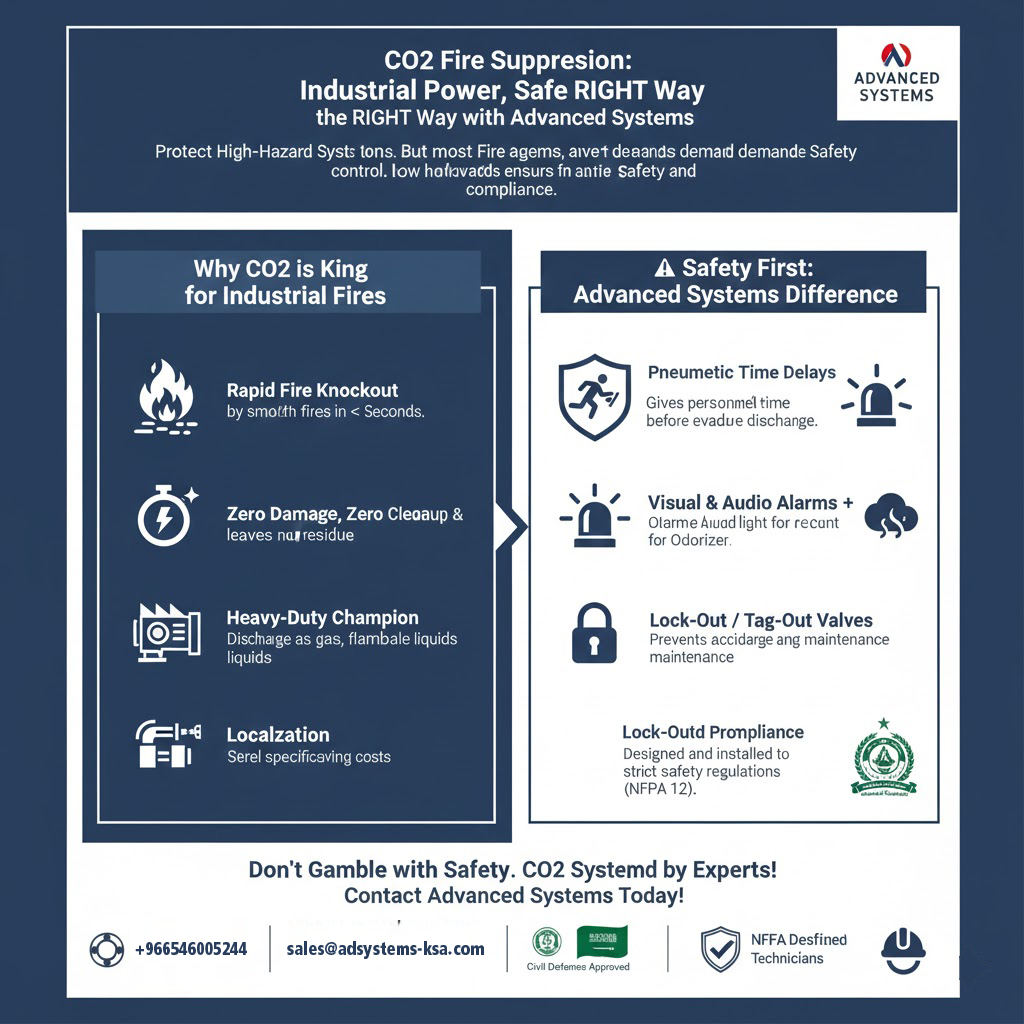
The Industrial Beast: Why CO2 Systems Are Still Unbeatable (And How to Install Them Safely)
If you’re running a power plant, a printing press, or a heavy manufacturing facility in Saudi Arabia, you don’t need “gentle” fire protection.
You need a beast.
When it comes to high-hazard industrial environments, there is one king that has ruled for over a century: The CO2 Fire Suppression System.
But here is the catch. CO2 is incredibly powerful, but if it’s installed by amateurs, it’s dangerous.
Today, I’m going to show you why CO2 is the ultimate industrial solution and why Advanced Systems is the partner you need to harness this power without risking your team’s safety.
Why CO2 is the “Heavyweight Champion” of Fire Suppression
Unlike Novec or FM-200, which are often used for delicate electronics, CO2 is built for aggressive fire fighting.
Here is why it’s still the top choice for industrial giants:
-
Total Oxygen Displacement: CO2 doesn’t just “cool” the fire; it suffocates it. By rapidly reducing oxygen levels, it kills the fire instantly.
-
Zero Residue, Zero Cleanup: Even though it’s “heavy-duty,” it’s still a gas. No foam, no water, no mess. You can restart your heavy machinery immediately after the system is cleared.
-
Local Application Expert: CO2 is unique because it can be used for “Local Application.” If you have one specific high-risk machine in a large factory, you can design the system to protect just that spot instead of flooding the whole building.
-
Cost-Effective Refills: CO2 is widely available and cheap to refill. For large-scale industrial sites, this makes it the most economical long-term choice.
The Danger Factor: Why You Can’t Cut Corners
I have to be honest with you. CO2 works by removing oxygen. That means it’s lethal to humans if they are in the room during discharge.
This is why you CANNOT hire a “cheap” contractor.
In Saudi Arabia, the Civil Defense has zero tolerance for safety violations regarding CO2. When you work with Advanced Systems, they build in “Safety-First” protocols that most others ignore:
-
Pneumatic Time Delays: To give everyone time to exit before discharge.
-
Warning Sirens & Odorizers: Adding a scent to the CO2 so people can “smell” the danger.
-
Lock-out Valves: To ensure the system doesn’t accidentally fire during routine maintenance.
[Image suggestion: Industrial machine room protected by CO2 nozzles]
Why Advanced Systems is the “Gold Standard” for CO2 in KSA
Advanced Systems doesn’t just “install pipes.” They engineer failsafe environments.
1. Expert Industrial Design
Whether it’s a “Total Flooding” for an unmanned engine room or a “Local Application” for a dip tank, their engineers calculate the exact CO2 concentration required by NFPA 12 and Saudi Civil Defense standards.
2. Civil Defense Approval (The “Green Light”)
Obtaining a permit for a CO2 system is tough. The authorities want to see perfect safety measures. Advanced Systems handles the entire approval process, ensuring your facility is 100% compliant with local laws.
3. Rigorous Maintenance
CO2 systems operate under high pressure. One loose fitting can be a disaster. Advanced Systems provides a maintenance schedule that includes hydrostatic testing and weight checks to ensure your cylinders are ready for action 24/7.
Conclusion: Power Requires Control
If your business involves flammable liquids, power generators, or large industrial machinery, CO2 is your best friend. But it’s a friend that needs to be handled with expert care.
Don’t gamble with human lives or your industrial assets.
Choose the system that works, and choose the company that knows how to make it safe.
Contact Advanced Systems today. Let’s protect your facility with the power of CO2—the right way.
by Mohamed Elbebhairy | Dec 17, 2025 | Products
Don’t Let Your Profits Go Up in Smoke: Why FM-200 is Still the Gold Standard for KSA Businesses
In the business world, downtime isn’t just an inconvenience. Downtime is a silent killer.
If you’re running a control room, a laboratory, or a telecommunications hub in Riyadh, Jeddah, or Dammam, you know that every second your systems are offline, you’re losing money.
Most business owners make a fatal mistake: They think any fire system will do.
But here’s the truth: If you use the wrong system, you might survive the fire but lose all your equipment to the “extinguishing agent” itself.
That’s where FM-200 comes in. It is the veteran of clean agent fire suppression. And today, I’ll show you why Advanced Systems is the only partner you should trust to install it.
Why FM-200 is the “Industry Favorite”
FM-200 (chemically known as HFC-227ea) isn’t just a fire extinguisher; it’s a high-tech insurance policy.
Here is why it remains the go-to choice:
-
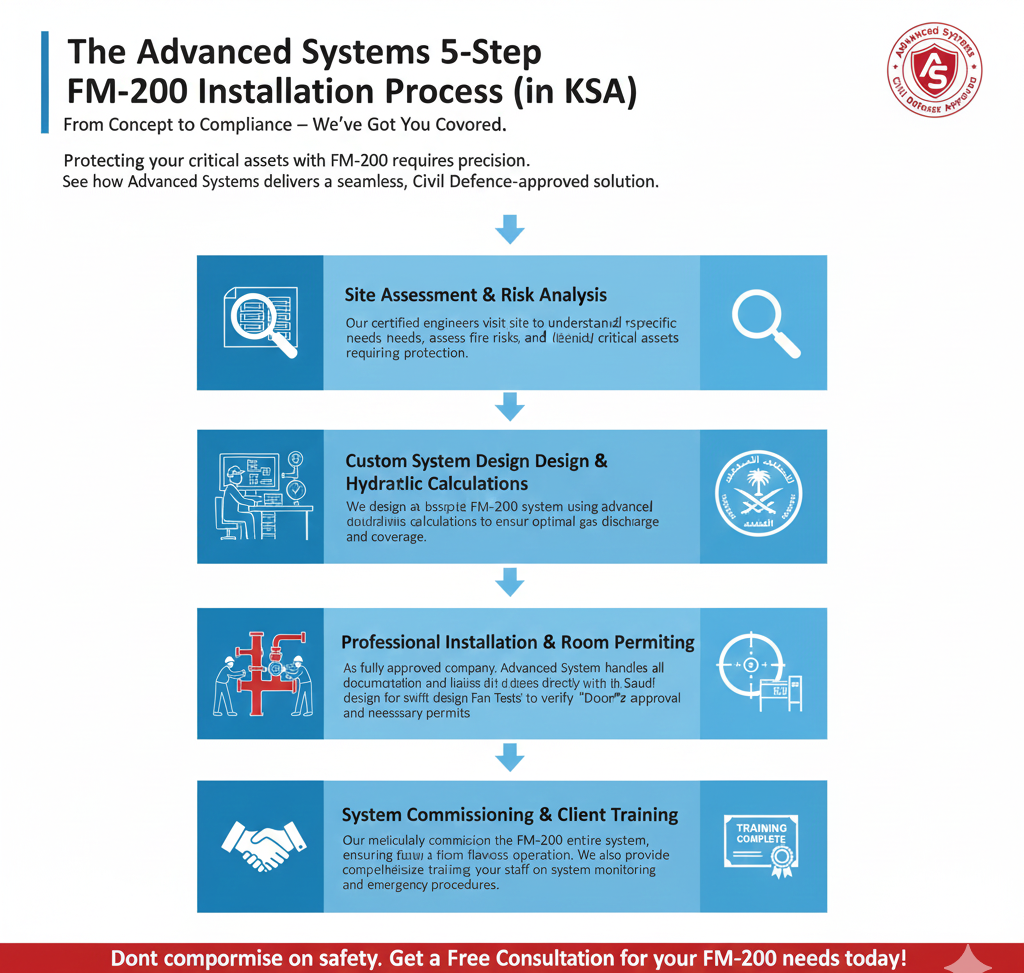
The 10-Second Rule: FM-200 doesn’t play around. It reaches extinguishing levels in 10 seconds or less. It stops the fire before it even has a chance to heat up your expensive hardware.
-
Zero Cleanup: Unlike foam or water, FM-200 is a gas. It leaves no oily residue, no water damage, and no dust. You don’t need a cleaning crew; you just need to get back to work.
-
Space Efficiency: FM-200 is stored as a liquid and discharged as a gas. This means it takes up significantly less storage space than CO2 or Inert Gas systems.
Why Advanced Systems is Your FM-200 Expert in Saudi Arabia
Buying the hardware is easy. Engineering the solution is where most companies fail.
In Saudi Arabia, the Civil Defense has strict requirements for gas suppression systems. You don’t just need a vendor; you need a certified engineering partner.
Here is how Advanced Systems sets you up for success:
1. Precision Hydraulic Calculations
FM-200 relies on pressure. If the pipe diameters or nozzle placements are off by even a few millimeters, the system won’t work. Advanced Systems uses specialized software to ensure the gas reaches every “blind spot” in your facility.
2. Full Civil Defense Approval (The “Fast Track”)
Stop wasting time with paperwork. As a Civil Defense-approved company, Advanced Systems ensures your FM-200 installation is compliant from day one. They help you secure your “Salamah” certification faster, so you can focus on scaling your business.
3. Room Integrity Testing (The Fan Test)
A gas system is useless if the room has leaks. Advanced Systems performs professional Door Fan Tests to ensure your room is airtight enough to hold the FM-200 concentration for the required “soak time.”
The Bottom Line: Protecting Your Future
Investing in an FM-200 system with Advanced Systems isn’t an expense. It’s a strategic asset.
The choice is yours: You can gamble with cheap, uncertified contractors and hope for the best… Or you can choose the most reliable system on the market, installed by the most trusted name in Saudi Arabia.
My advice? Call Advanced Systems today. Get your facility audited, get your FM-200 system designed by pros, and sleep better at night.
by Mohamed Elbebhairy | Dec 8, 2025 | Events
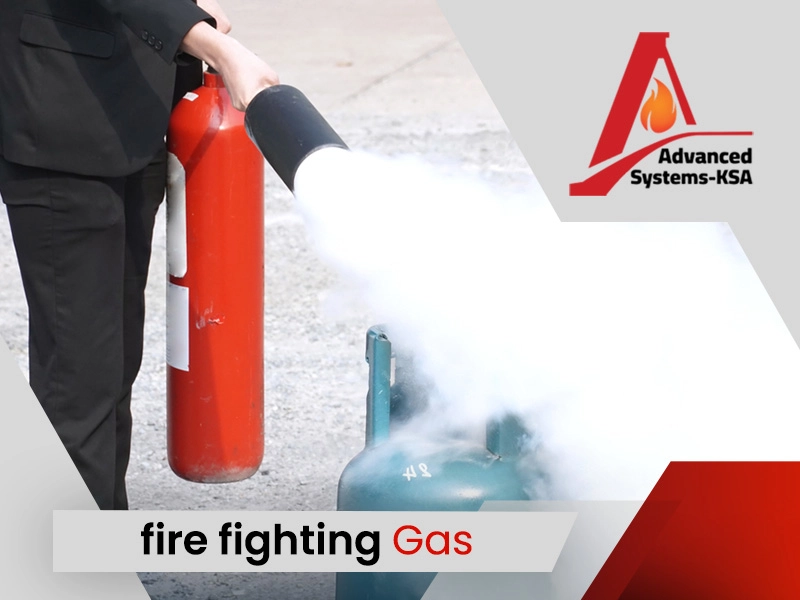
Selecting the appropriate fire fighting gas is crucial in securing assets and facilities. With a notable presence in the industry, Advanced Systems takes excellent satisfaction in unveiling its experience in Egypt and KSA, solidifying its dedication to providing exceptional firefighting solutions. In this article, we will explore the types of fire fighting gases.
Fire Fighting Gas Systems Overview
Firefighting gases are substances used to suppress or extinguish fires. They are typically stored in pressurized containers and released into an area affected by fire to displace oxygen or cool down the fire. Different types of these gases have varying mechanisms of action and are used in different scenarios.
Types of Fire Fighting Gas:
The following are some commonly used gases:
CO2 System Fire Fighting
One of the most widely used fire gas systems is the CO2 system. Carbon dioxide (CO2) is a colorless, odorless gas displacing oxygen when released into a fire-affected area, smothering the flames. This gas is particularly effective for suppressing Class B and Class C fires involving flammable liquids and electrical equipment. Advanced Systems provides state-of-the-art CO2 system firefighting solutions tailored to the specific needs of their clients.
Halon
Halon gases (such as Halon 1211 and Halon 1301) were widely used to suppress fires effectively. However, their production has been phased out due to their ozone-depleting properties. Halon gases work by interrupting the chemical reaction of fire.
Clean Agents
They are electrically non-conductive, leave no residue, and have a low global warming potential. Clean agents work by absorbing heat and interrupting the combustion process. These agents include:
- FM 200 fire fighting: This clean agent gas has gained popularity due to its exceptional extinguishing capabilities and environmentally friendly nature. FM 200 rapidly suppresses fires by absorbing heat energy and interrupting combustion. It is highly effective for safeguarding critical assets like data centers, control rooms, and valuable equipment. Advanced Systems proudly offers FM 200 firefighting solutions, ensuring optimal fire suppression in sensitive environments.
- NOVEC fire fighting: This advanced extinguishing agent combines exceptional fire suppression capabilities with minimal environmental impact. Novec gas removes heat from the fire, resulting in rapid cooling and extinguishment. Its low toxicity and zero residue protect valuable assets like museums, libraries, and archives. Advanced Systems brings the power of Novec firefighting to Egypt and KSA, providing localized support to regional clients.
Inert Gases
Inert gases, such as nitrogen and argon, play a crucial role as firefighting agents in specific situations. Their effectiveness lies in reducing oxygen concentration within the affected area, a mechanism akin to carbon dioxide. Particularly advantageous in environments with valuable or sensitive equipment, inert gases offer a distinct advantage: they suppress fires without causing any damage or leaving residue behind. This makes them a preferred and reliable choice for targeted fire suppression in areas where the preservation of equipment integrity is paramount.
Water Mist
Water mist systems use fine water droplets to suppress fires. The mist helps cool down the fire and displace oxygen. Water mist systems are commonly used in areas where water damage needs to be minimized, such as server rooms or museums.
It’s important to note that the selection of the appropriate fire fighting gas system depends on the type of fire, the environment, and the potential risks associated with using a particular agent. Firefighting professionals and experts follow specific guidelines and regulations to determine the most suitable system for each scenario.
Advanced Systems: Your Trusted Fire Safety Partner
With a strong presence in Egypt and a recent expansion into Saudi Arabia, Advanced Systems is committed to delivering state-of-the-art firefighting solutions. As a trusted partner, we offer a comprehensive range of services. Our team of experts ensures the seamless integration of fire gas systems into diverse environments, providing clients with peace of mind and enhanced fire safety.
Contact us to learn more about our firefighting solutions and how they can safeguard your environment from the devastating impact of fires.
Read More:
Fire hydrant and monitor
Fire Alarm Devices
Fire water pump
Fire Sprinklers
Fire hydrant
Conventional Fire Alarm Panels
Foam Firefighting Equipment
by Mohamed Elbebhairy | Dec 7, 2025 | Products
If you are doing business in Saudi Arabia right now, you are in the middle of one of the biggest infrastructure booms in history. Vision 2030 is transforming the landscape.
But with rapid growth comes strict regulation.
The General Directorate of Civil Defense (GDCD) in Saudi Arabia does not play games. If your facility isn’t up to code, you aren’t just risking a fine. You are risking your license, your reputation, and your revenue.
So, how do you navigate the complex web of fire safety regulations without losing your mind?
You don’t do it alone. You hire the best.
Today, I want to talk about Advanced Systems, and why they are the Civil Defense-approved partner you need to scale safely.
The “Hidden” Cost of Non-Compliance
Most entrepreneurs focus on marketing, sales, and logistics. They treat fire safety as a “check-the-box” task.
This is a huge mistake.
In Saudi Arabia, the Salamah regulations are rigorous. The Civil Defense requires certified vendors for installation, maintenance, and supervision.
If you cut corners here, you face:
-
-
Operational Downtime: The government can seal your doors until you are compliant.
-
Insurance Nightmares: If a fire happens and your systems weren’t certified, your coverage is likely void.
-
Brand Damage: Trust is hard to build and easy to lose.
Fire Safety
You need a partner that understands the local ecosystem.
Enter: Advanced Systems
There are dozens of fire safety companies in KSA. Why am I highlighting Advanced Systems?
Because in business, speed and precision matter.
Advanced Systems isn’t just a hardware vendor; they are a compliance solution. They are fully approved by the Civil Defense to handle the heavy lifting for you.
Here is why they stand out from the competition:
1. End-to-End Certification (The “Done-For-You” Approach)
You don’t have time to deal with three different contractors—one for design, one for installation, and one for the legal paperwork.
Advanced Systems handles the entire lifecycle. From the initial engineering drawings approved by the Civil Defense to the final installation of sprinklers, alarms, and pumps.
2. Smart Technology Integration
We live in a digital world. Your fire safety shouldn’t be stuck in the 1990s.
Advanced Systems utilizes modern fire detection tech that integrates with building management systems. This means faster response times and fewer false alarms.
3. Maintenance That Actually Happens
Getting the certificate is step one. Keeping it is step two.
The Civil Defense requires regular maintenance logs. Advanced Systems provides scheduled maintenance contracts that keep you “audit-ready” 24/7/365.
How Safety Drives ROI
You might be thinking, “Neil, how does buying fire extinguishers give me a Return on Investment?”
It’s simple. Stability.
Investors and big partners in Saudi Arabia look for risk mitigation. When you can prove that your facility (whether it’s a warehouse, a hotel, or an office tower) is secured by a top-tier provider like Advanced Systems, your valuation goes up.
You are signaling to the market that you are a serious player.
Here is the bottom line:
You can spend months trying to figure out the regulations yourself, or you can partner with Advanced Systems, get your license, and get back to what you do best—growing your business.
Don’t let a safety audit be the bottleneck that stops your growth.
Page 7 of 11« First«...56789...»Last »