
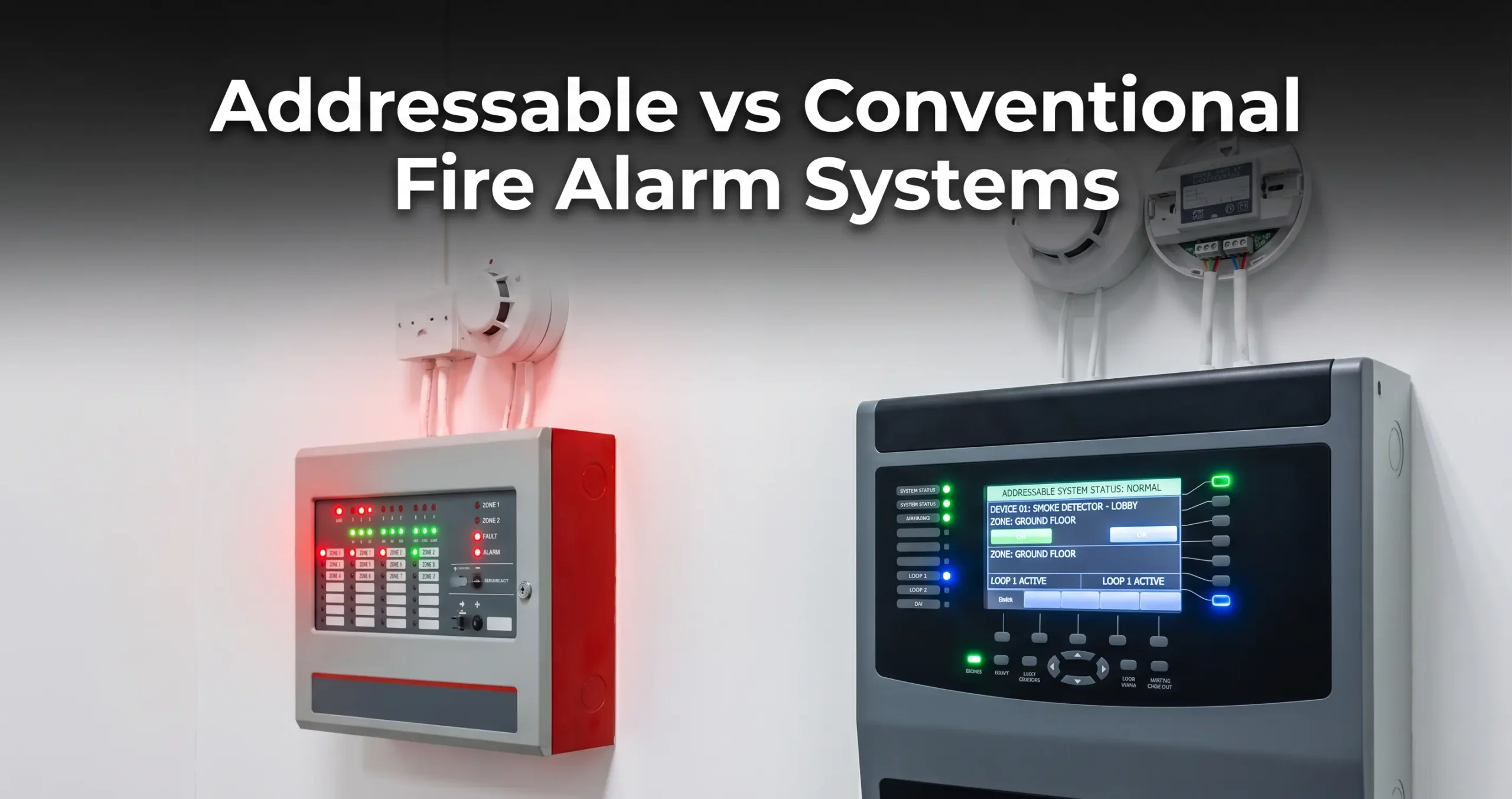
Selecting between addressable and conventional fire alarm systems is one of the most consequential fire protection decisions a facility owner, developer, or project manager can make. The wrong choice affects detection accuracy, emergency response speed, maintenance complexity, and long-term system management capability — all of which have direct implications for life safety and regulatory compliance. Advanced Systems designs, supplies, and installs both addressable and conventional fire alarm systems across Saudi Arabia, providing expert engineering guidance that ensures every client receives the system architecture best matched to their facility type, size, and operational requirements — fully compliant with NFPA 72 and Saudi Civil Defense standards.
Understanding the Core Difference
The fundamental distinction between addressable and conventional fire alarm systems lies in how each system communicates detection information back to the fire alarm control panel — and how precisely that information identifies the location of an alarm event within the facility.
In a conventional fire alarm system, detectors and call points are wired together in zones. When a device activates, the control panel identifies which zone has triggered — but not which specific device within that zone. In a building with large zones covering multiple rooms or an entire floor, this means the responding team must physically search the entire zone to locate the fire source, losing critical time in the process.
In an addressable fire alarm system, every single detector, call point, and module on the network has a unique electronic address. When any device activates, the control panel immediately identifies that exact device by name and location — displaying precise information that allows emergency responders to go directly to the fire source without any search delay. This precision is the defining operational advantage of addressable technology, and it becomes increasingly critical as building size and complexity increase.
Conventional Fire Alarm Systems: Capabilities and Limitations
A conventional fire alarm system uses a straightforward wiring architecture where multiple detectors share a common circuit back to the control panel. Each circuit represents a zone, and the panel indicates zone-level alarm, fault, or normal status through dedicated indicator LEDs or a simple display.
Conventional systems offer genuine advantages in specific contexts:
- Lower initial installation cost for small, simple facilities where zone-level information is sufficient for effective emergency response.
- Simple design and straightforward maintenance — technicians familiar with basic electrical systems can work on conventional panels without specialist software tools.
- Proven reliability in small commercial buildings, individual retail units, and light industrial spaces where the total protected area is limited and zone boundaries are clearly defined.
- Cost-effective for retrofit projects in existing buildings where rewiring to addressable standards would be prohibitively disruptive or expensive.
However, conventional systems carry significant limitations that make them unsuitable for medium to large facilities:
- Zone-level identification only — in a large zone covering multiple rooms, locating the actual fire source requires a physical search that wastes precious response time.
- Limited fault diagnostics — identifying the specific device causing a fault requires manual inspection of the entire zone circuit.
- Scalability constraints — expanding a conventional system as a facility grows requires additional panel zones and cabling that quickly becomes costly and complex.
- No device-level monitoring — gradual detector contamination or sensitivity drift is not detectable until the device fails entirely or generates false alarms.
Addressable Fire Alarm Systems: Precision, Intelligence, and Scalability
An addressable fire alarm system communicates with every device on the network individually using a digital protocol over a loop circuit — a single cable that connects all devices in sequence and returns to the panel, providing inherent circuit redundancy. Each device’s unique address allows the control panel to poll it continuously, monitor its status in real time, and receive precise alarm or fault information instantly.
The operational and technical advantages of addressable systems are substantial:
- Exact device identification: Every alarm and fault event is reported with the specific device name, location description, and zone — eliminating search time and enabling immediate, targeted emergency response.
- Continuous device health monitoring: Addressable panels monitor detector sensitivity levels in real time, flagging devices that are drifting toward contamination or failure before they cause false alarms or actual detection failures.
- Cause and effect programming: Sophisticated control logic allows specific detectors to trigger specific outputs — activating door holders, controlling ventilation dampers, releasing magnetic locks, initiating suppression sequences, and triggering elevator recall — all automatically and with precision.
- Scalability and flexibility: Adding devices to an addressable loop is straightforward — simply assign a new address and connect to the existing loop without running new circuits back to the panel.
- Comprehensive event logging: All alarm events, faults, test activities, and operator actions are time-stamped and stored in the panel’s memory — providing a complete audit trail for compliance, insurance, and incident investigation purposes.
- Reduced false alarm rates: Advanced addressable panels with intelligent detector algorithms can distinguish between genuine fire signatures and nuisance sources — dramatically reducing false alarms that disrupt operations and desensitize occupants to alarm signals.
Addressable vs. Conventional: A Direct Comparison
Understanding the full range of Fire Alarm Types available — and how addressable and conventional architectures compare across the criteria that matter most — is essential to making the right system selection for your facility:
- Detection Location Accuracy: Addressable — exact device; Conventional — zone only.
- Device Health Monitoring: Addressable — continuous real-time; Conventional — not available.
- False Alarm Intelligence: Addressable — advanced algorithms available; Conventional — basic threshold only.
- System Scalability: Addressable — highly scalable on existing loops; Conventional — requires new circuits and zones.
- Maintenance Efficiency: Addressable — remote fault identification, no physical search; Conventional — manual zone circuit inspection required.
- Integration Capability: Addressable — full BMS, suppression, access control, and HVAC integration; Conventional — limited relay-based outputs only.
- Initial Cost: Addressable — higher upfront; Conventional — lower upfront.
- Long-Term Value: Addressable — significantly lower lifecycle cost through reduced maintenance time, fewer false alarms, and superior system management capability.
- Best Application: Addressable — medium to large, complex, or multi-occupancy facilities; Conventional — small, simple, single-occupancy buildings.
How Advanced Systems Selects the Right Architecture for Your Project
Advanced Systems does not apply a one-size-fits-all approach to fire alarm system design. Our engineering team evaluates each project individually — assessing facility size, floor plan complexity, occupancy type, hazard classification, Civil Defense zone requirements, integration needs, and budget constraints — before recommending the system architecture that delivers the optimal balance of performance, compliance, and lifecycle value for that specific project.
For projects requiring the highest level of detection intelligence and system integration, Advanced Systems specifies and installs the Potter Fire Alarm System — a globally certified addressable platform with advanced cause-and-effect programming, comprehensive event logging, and reliable suppression panel interfacing that has proven its performance across commercial, industrial, healthcare, and infrastructure projects throughout Saudi Arabia and internationally.
Every fire alarm installation we deliver is designed as part of a complete, integrated fire protection strategy — coordinated with suppression systems, fire fighting pump sets, Mild Steel and Stainless Steel Fire Cabinets for first-response hose reel access, and Booster and Sewage Pump Solutions that ensure reliable building services infrastructure supports the fire protection system’s full operational capability.
Advanced Systems: Your Fire Alarm System Specialist in Saudi Arabia
Advanced Systems brings deep technical expertise in both addressable and conventional fire alarm systems to every project, combined with a certified product portfolio, rigorous NFPA 72 compliance, and a project delivery process that covers design, Civil Defense approval, professional installation, commissioning, and long-term maintenance support — all under one contract. Whether your project calls for a simple conventional system in a small facility or a sophisticated multi-loop addressable installation across a complex high-rise or industrial development, Advanced Systems has the knowledge and capability to deliver a fire alarm solution that performs exactly as required when it matters most.
Contact Advanced Systems today to discuss your fire alarm system requirements and receive a tailored engineering proposal for your facility.
Frequently Asked Questions
What is the main advantage of an addressable fire alarm system over a conventional one?
The primary advantage of an addressable fire alarm system is precise, device-level identification of every alarm and fault event — allowing emergency responders to go directly to the exact location of a fire rather than searching an entire zone. This precision significantly improves emergency response speed and reduces the risk of fire spreading before suppression measures are applied.
When is a conventional fire alarm system still an appropriate choice?
A conventional fire alarm system remains appropriate for small, simple facilities — such as individual retail units, small offices, or light industrial spaces — where the total protected area is limited, zones are clearly defined, and zone-level alarm information is sufficient for effective emergency response. For any facility of significant size or complexity, an addressable system is strongly recommended.
What standard governs fire alarm system design in Saudi Arabia?
Fire alarm system design and installation in Saudi Arabia must comply with NFPA 72 — the National Fire Alarm and Signaling Code — alongside applicable Saudi Civil Defense regulations. Advanced Systems designs every installation to full NFPA 72 compliance and manages Civil Defense technical submissions on every project.
Can an existing conventional fire alarm system be upgraded to addressable?
Yes. Advanced Systems has extensive experience upgrading conventional fire alarm systems to modern addressable platforms — including panel replacement, device upgrades, and loop rewiring — in occupied facilities, carefully planned to maintain continuous fire protection coverage throughout the upgrade process.